
FIVE Things I Learned From My Lengthy Ironsworn Campaign
It's always good to try and figure out lessons to take forward

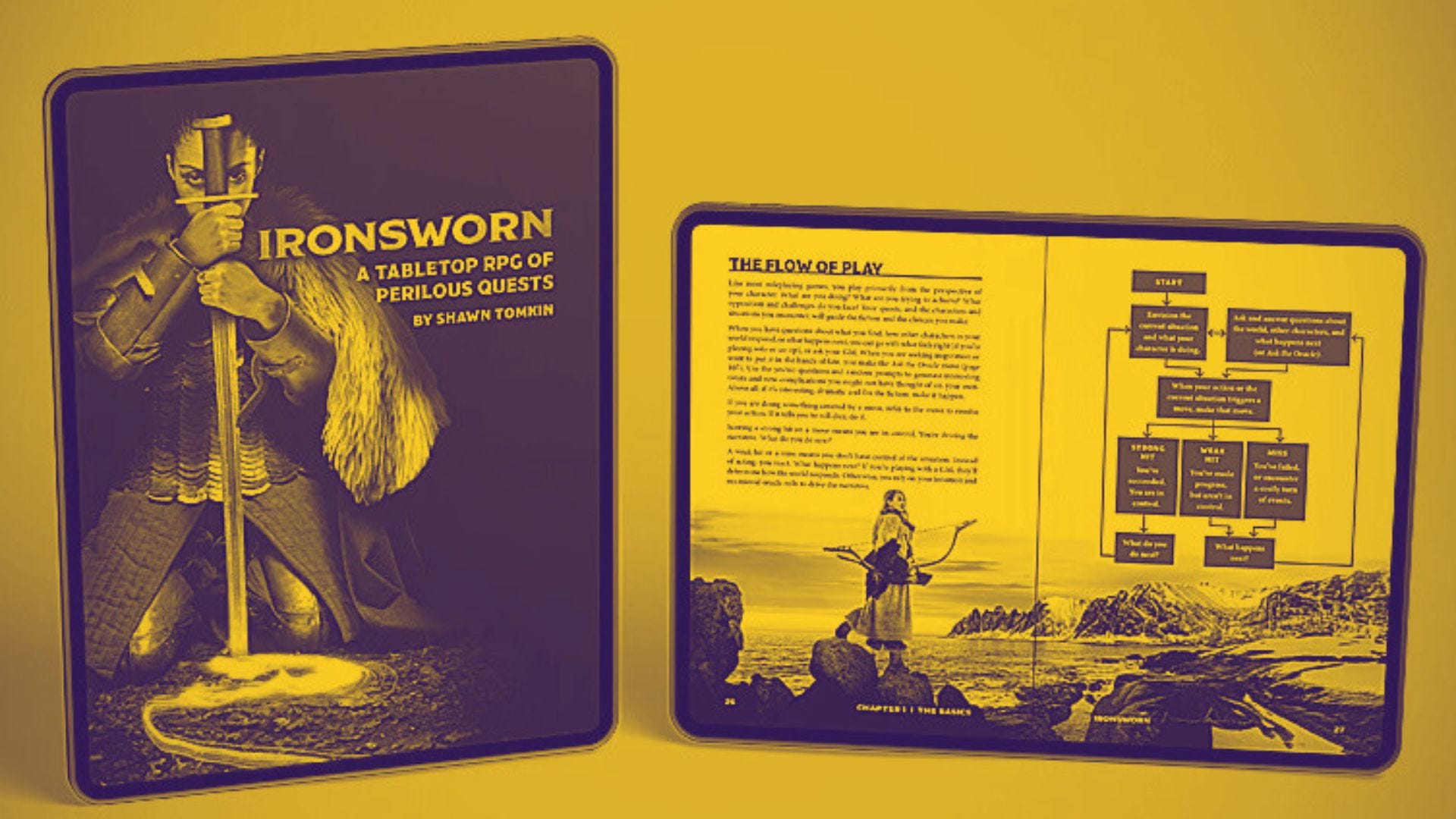
So, farewell then, Olvir, the (not so) forgotten.
In case you missed the memo (or my most recent post), Olvir the Forgotten finally got to make the “Write your Epilogue” move. It rolled as a weak hit, meaning (to me) that whilst Olvir is hanging up his dagger and adventurer’s backpack, he doesn’t get to sit on his arse from now on. No, sir, he has a job to do—probably a long-term one.
Well, it’s more of a calling than a job, to be fair. He’ll probably end up fronting the ministry of healing to the victims of The Iron Draught even after his Great-Great Uncle shuffles off this mortal coil.
Looking back on this series, which astonishingly began on 23rd March, I started reflecting on what I learnt from engaging with a 9-month campaign. So, here I present the somewhat unformed, slightly off-the-top-of-my-head, FIVE things I learned from the Redemption of Olvir, the Forgotten.
1. It helped me understand the solo TTRPG hobby.
Last March, I began solo tabletop roleplaying much like many others—curious, hopeful, and a bit confused. I wanted stories. I wanted surprises. I sought that elusive lightbulb moment people describe when a d10 and our imagination come together.
What I initially experienced felt more like spinning my rear wheels after reversing into a muddy verge.
I bounced from game to game. I read the rules, skimmed examples, and even tried short sessions. Each attempt finished the same way. I stalled after a couple of scenes. I blamed the games, then blamed myself, then blamed the dice, then blamed the weather…
Nothing seemed to “work”.
Ironsworn changed that, not because it’s necessarily “the best game”, but through commitment. I chose one game and stopped searching for the next shiny thing. This hobby began to make sense once I stopped treating it like a buffet and started tucking in to a healthy meal.
That only clicked for me after weeks of playing in the same fictional world.
Repetition trained my instincts. I stopped asking what I should do next. I began asking what made sense given what had already happened. The hobby morphed from feeling like an intractable puzzle and became “play” (at last!)
2. It sharpened my writing.
Honestly, I did not intend to write so much. I aimed to play a game and jot down notes. The idea of what I later learned are called “Actual Plays”, came later.
This campaign ran for 27 episodes. Most ranged between 1200 and 1400 words. The final total exceeded 40,000 words. I don’t say that as a brag. I say it as the reason my writing got better over those weeks and months.
Here’s the honest truth. When I look back now, some of those early entries read a little … ummm… “rough”. Flat verbs. Rushed dialogue. Scenes that end without resolution. I can see the issues clearly now… with the benefit of hindsight (and improvement)
Writing “AP” (another acronym I learned) requires a particular kind of discipline. When we write free posts on a platform like Substack, there is no editor waiting and no audience expecting their paid-for posts. The only reward is found within the work itself.

Did I become a better writer? Yes, and here is why. Writing 40,000 words forced me to focus on structure, rather than simply rambling. You know, things like requiring a beginning, middle, and end. And discovering that scenes need tension to avoid falling flat on the page. And discovering that each paragraph needed a reason to be there. “Proper” writing stuff, in other words!
I learned to write faster. I learned to edit better. I learned that purple prose feels boring to casual readers after three paragraphs. Most of all, I realised that since the game kept going, the writing had to keep up.
3. It grew me as a player
Solo play might seem entirely relaxed for an outsider. It doesn’t depend on other players’ schedules. No table drama. No late-night pizza. That serenity hides effort. Good solo play needs focus and patience.
A lengthy campaign requires something we often lack in modern-day life. Persistence.
I had to learn the rules properly or face frustration and endless checking in the book. I studied all the various “moves” and pored over my “asset” cards. I learned when to roll and when to just narrate what I thought should happen next. That persistence paid off. Eventually.
Once I recognised that truth, my play improved. Scenes became more intense. Consequences felt more meaningful, and the (rare) victories felt truly earned.
That shift marked genuine growth as a player. I learned to trust the process. I learned to slow down. I realised that boredom often signals superficial engagement, not a poor game.
Most importantly, now that I know how to persist with a campaign, I can enjoy both the excitement of a good one-shot and the satisfaction of a mini-campaign, while knowing I can return to my longer campaign at any time.
4. It made me learn one system in depth.
“Which game should I start with?” It’s an almost daily question in Reddit forums and Facebook Groups dedicated to this hobby. The answers tend to follow a similar pattern. One person recommends Four Against Darkness, while another praises Dragonbane. Visit DriveThru RPG to download this game or find a free game on Itch. It rarely takes more than three posts before Ironsworn is mentioned…
Let me tell you: that noise diminishes once you dedicate yourself to mastering one system.
Ironsworn belongs to the Powered by the Apocalypse family. Opinions differ. Some love it. Others seem to hate it with a passion. That argument misses the point. “Systems” become less important once we drill down and commit to one.

Sticking with one system lets me see its core structure. I understood why the moves behaved as they did. I saw how progress tracks influenced pacing. I learned the rhythm of weak hits and misses. That rhythm became familiar, then comforting.
Once that foundation was settled, tinkering felt natural. I added new assets, wrote custom moves, and tweaked oracles to match my tone. None of it felt risky; I knew what I was changing and why.
Deep system understanding fosters confidence. We cease fearing “errors”. House rules develop, and our play acquires depth.
That depth never manifested during my earlier game-hopping phase. Each new system resets the learning curve. Commitment changed that equation.
5. It taught me a quiet lesson underneath it all
When I look back on the journey of Olvir across the Ironlands, I come to one inescapable truth: Commitment did the work.
Not talent. Not luck. Not the perfect tool or oracle.
The truth is that I’m not a great writer. I’m decent enough, and I believe I’ve improved a bit through this project, but I’m no Shakespeare or Tolkien. I’m not even a Brandon Sanderson or George R.R Martin.
But choosing one game and sticking with it gave me space to learn. I learned the hobby. I developed my writing craft. I understood a system from the inside.
Like any path, this one will not suit everyone. Some players thrive on variety, and some writers require novelty. You do you.
But for anyone stuck at the edge of solo play, commitment offers a simple experiment. Pick one game. Play it longer than feels comfortable. Write more than feels tidy. See where it leads you.
I’ve come to believe that solo TTRPG play rewards patience. Persistence. It teaches us through repetition.
And I trust that lesson will stay with me long after Olvir has been long …errr… Forgotten!
Did you miss anything in the Redemption of Olvir, the Forgotten? You can find links to everything on my curated Contents Page. Just smash the orange button below.
Great article, Paul. I enjoyed your Ironsworn series and also enjoy your other APs as well. Your writing is always engaging and keeps me coming back for more!
Great article as usual, Paul.
A lot of what you put in your article I found myself nodding along with as my experiences were very similar.
I landed on Starforged rather than Ironsworn, but even then I found myself going to Iron Valley to really get comfortable with the system and the went back to Starforged once I was more comfortable with things.